
Table of Contents
ToggleLongevity Training: How to Live Longer and Stronger—The Complete 2026 Guide Introduction
Introduction
Your body isn’t meant to break down after 50. Yet millions of Americans are experiencing exactly that—losing muscle mass, feeling weaker, and watching their independence slip away.
Here’s what changed: Longevity training isn’t about looking good at the beach anymore. It’s about living better for longer.
According to a 2025 Wakefield Research survey, 60% of Americans now list longevity and healthy aging as their top fitness motivator. This shift represents a fundamental change in how we think about exercise. We’re no longer chasing six-pack abs; we’re chasing vitality.
Longevity training focuses on building functional strength, improving mobility, maintaining bone density, and protecting your cardiovascular health—all the things that keep you independent, active, and thriving as you age.
The good news? It’s never too late to start. Whether you’re 30 or 70, the principles of longevity training can add years to your life and life to your years.
In this guide, I’ll show you exactly how to build a longevity training program that works for your body, your schedule, and your goals.
What is Longevity Training?
Longevity training is a science-based approach to fitness designed to maximize healthspan—the number of years you live in good health—rather than just lifespan.
It combines:
Functional strength training (movements that translate to real life)
Cardiovascular conditioning (for heart health)
Flexibility and mobility work (for movement quality)
Balance training (to prevent falls)
Stress management (for mental resilience)
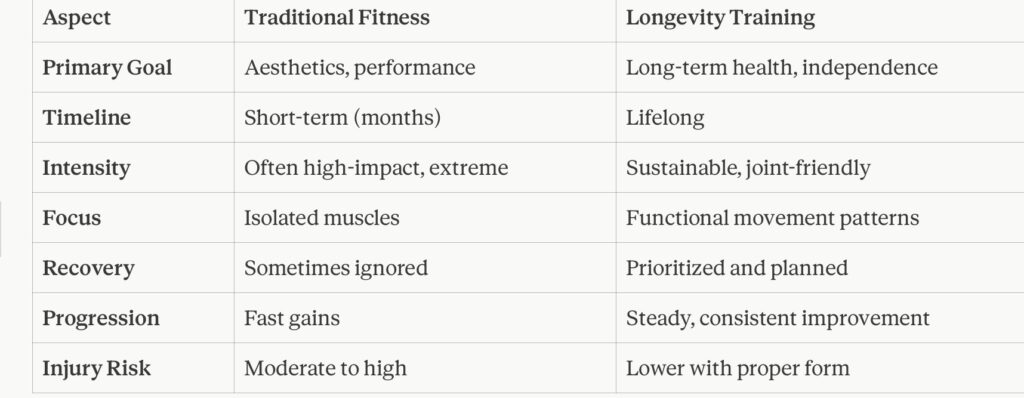
Unlike traditional bodybuilding or extreme fitness trends, longevity training is sustainable, injury-resistant, and tailored to your individual needs.
The goal isn’t to become an athlete. The goal is to remain capable, independent, and energetic for decades to come.
How Longevity Training Differs from Regular Exercise
Why Longevity Training Matters More Than Ever
The Aging Crisis in America
Americans are living longer, but not always better. Here’s what the data shows:
1 in 4 adults over 65 fall each year
33% of Americans over 45 experience some form of mobility limitation
Muscle loss accelerates after age 30 at a rate of 3-8% per decade
Bone density decline increases fracture risk dramatically in older adults
But here’s the hopeful part: Longevity training can reverse many of these trends.
The Longevity Training Advantage
Research from the Mayo Clinic and American Heart Association shows that people who engage in consistent strength training and functional fitness:
- Live 3-7 years longer on average
- Maintain independence longer
- Experience fewer chronic diseases
- Have better mental health and cognitive function
- Enjoy a higher quality of life
This isn’t speculation. It’s documented in peer-reviewed studies.
The Science Behind Longevity Training and Aging
How Your Body Ages
Aging happens at the cellular level, but the effects are visible in three main areas:
1. Muscle Loss (Sarcopenia)
Without targeted stimulus, you lose about 0.5% of muscle mass per year after age 25. This accelerates after 65.
How longevity training helps: Resistance training triggers muscle protein synthesis, maintaining and building muscle regardless of age.
2. Bone Density Decline
Bones become brittle without mechanical stress. Women especially face osteoporosis risk after menopause.
How longevity training helps: Weight-bearing exercises create the stress bones need to stay dense and strong.
3. Cardiovascular Decline
Your heart’s efficiency decreases about 10% per decade without intervention.
How longevity training helps: Consistent cardio and interval training maintain heart strength and circulation.
The Longevity Training Timeline
What happens to your body when you start longevity training?
Weeks 1-2: Nervous system adaptation, better movement quality
Weeks 3-4: Increased energy, better sleep
Weeks 5-8: Noticeable strength gains, improved mood
Weeks 9-12: Significant cardiovascular improvements, visible muscle tone
3-6 months: Sustained energy, better body composition, improved bone markers
6-12 months: Major lifestyle transformation, measurable health improvements
7 Essential Exercises for Longevity Training
These exercises form the foundation of any longevity training program. They’re functional, scalable, and safe when performed correctly.
1. Goblet Squats
Why it matters: Builds leg strength, improves mobility, strengthens knees and hips.
How to do it:- Hold a dumbbell at chest height
- Lower your body as if sitting in a chair
- Keep your weight in your heels
- Stand back up without locking knees
- Longevity benefit: Maintains the ability to stand up from a chair—essential independence.
Progression: Start with 15-20 lbs, increase weight gradually.
2. Push-ups (Modified or Full)
Why it matters: Maintains upper body strength, chest health, shoulder stability.
How to do it: - Start in plank position (hands under shoulders)
- Lower your body until chest nearly touches the ground
- Push back up
- Modify on knees or against a wall if needed
Longevity benefit: Preserves the upper body strength needed for daily tasks.
Progression: Wall push-ups → Incline push-ups → Full push-ups.
3. Deadlifts (with Light Weight)
Why it matters: Strengthens the posterior chain, improves posture, protects your back.
How to do it: - Stand with feet hip-width apart
- Hold a dumbbell or barbell at thigh level
- Lower the weight by hinging at hips (not squatting)
- Return to standing position
Longevity benefit: Prevents the forward slouch that develops with age.
Progression: Bodyweight → Dumbbell → Barbell as strength increases.
4. Walking Lunges
Why it matters: Builds single-leg strength, improves balance, strengthens glutes and quads.
How to do it: - Stand tall
- Step forward with one leg
- Lower your body until both knees are bent at 90 degrees
- Push through front heel to return to start
- Alternate legs
Longevity benefit: Enhances stability for walking, climbing stairs, and preventing falls.
Progression: Bodyweight → Holding dumbbells → Adding a pause at the bottom.
5. Plank Holds
Why it matters: Strengthens core, improves posture, protects the spine.
How to do it: - Hold a plank position (elbows under shoulders)
- Keep your body in a straight line
- Hold for 30-60 seconds, rest, repeat
Longevity benefit: A strong core prevents falls and back pain—two major issues in aging.
Progression: Progress from 30 seconds to 2-3 minutes, add movement variations.
6. Farmer’s Carries
Why it matters: Builds grip strength, stabilizes shoulders, improves posture.
How to do it: - Hold a dumbbell or kettlebell in each hand
- Walk for 30-60 seconds
- Set down and rest
Longevity benefit: Grip strength is a predictor of longevity and independence.
Progression: Increase weight, distance, or time.
7. Incline Walking (The 12-3-30 Workout)
Why it matters: Excellent cardiovascular training without joint stress.
How to do it: - Set treadmill to 12% incline
- Walk at 3 mph for 30 minutes
- This trend went viral for a reason—it works
Longevity benefit: Builds cardiovascular fitness while being low-impact on joints.
Science: A recent study showed this matches the calorie burn of traditional running with less injury risk.
Building Your Longevity Training Program
The Weekly Framework
Here’s a sample week of longevity training suitable for beginners to intermediate athletes:
Monday: Strength Focus
- 5-minute warm-up (easy walking)
- Goblet squats: 3 sets of 10-12 reps
- Push-ups: 3 sets of 8-10 reps
- Plank holds: 3 sets of 45 seconds
- 5-minute cool-down
Tuesday: Cardio Focus
- 30 minutes incline walking (12% incline, 3 mph)
- OR 20 minutes moderate cycling
- OR 30 minutes brisk walking
Wednesday: Mobility and Recovery
- 15-minute yoga or stretching
- Foam rolling
- Breathing exercises
Thursday: Strength Focus
- 5-minute warm-up
- Deadlifts: 3 sets of 8-10 reps
- Walking lunges: 3 sets of 10 per leg
- Farmer’s carries: 3 sets of 45 seconds
- 5-minute cool-down
Friday: Active Recovery
- 20-30 minutes easy walk
- Light stretching
- Breathing work
Saturday & Sunday: Rest or Gentle Movement
- One rest day, one active recovery day (walk, swim, yoga)
Progressive Overload in Longevity Training
Longevity training still requires progression—but at a sustainable pace.
How to progress safely:
- Increase reps (before increasing weight)
- Increase sets (add another set every 2-3 weeks)
- Increase weight (5-10% increases are ideal)
- Decrease rest periods (do sets faster, with same effort)
- Add variations (single-leg versions, paused reps)
The key: Progress slowly. Small, consistent improvements compound into major transformations over months and years.
Nutrition Strategies to Support Your Training
Longevity training requires proper fuel. Here’s what the science says:
Protein Intake
Target: 0.7-1 gram per pound of body weight daily
- Supports muscle recovery
- Signals your body to maintain muscle
- Prevents muscle loss with age
Best sources: Eggs, fish, Greek yogurt, lean meat, legumes, tofu
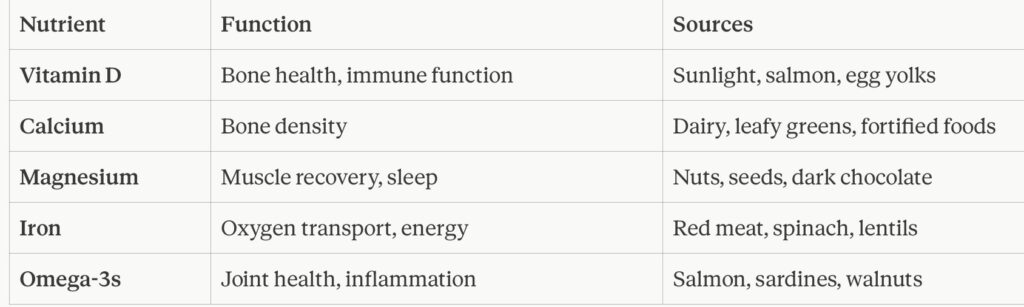
Micronutrients for Longevity Training
Hydration
- Drink 35 ml per kg of body weight daily
- More on training days
- Proper hydration improves recovery and performance
Timing Matters
- Pre-workout (30-60 min before): Carbs + small protein (banana + handful of almonds)
- Post-workout (within 2 hours): Protein + carbs (Greek yogurt + berries)
Recovery and Sleep: The Forgotten Pillar
Here’s a truth about longevity training: You don’t get stronger in the gym. You get stronger during recovery.
Sleep and Longevity Training
Research is clear: poor sleep sabotages longevity training results.
During sleep:
- Muscle protein synthesis increases by up to 40%
- Cortisol (stress hormone) decreases
- Growth hormone peaks
- Cognitive function restores
Target: 7-9 hours nightly for optimal results.
Sleep tips:
- Consistent bed time (even weekends)
- Dark, cool room (60-67°F ideal)
- No screens 1 hour before bed
- Avoid caffeine after 2 PM
Active Recovery Days
These aren’t “off days”—they’re strategic rest.
On active recovery days:
- Walk 20-30 minutes
- Do light stretching or yoga
- Use a foam roller
- Practice breathing exercises
This keeps blood flowing, speeds recovery, and maintains momentum.
Deload Weeks
Every 4-6 weeks, reduce training volume by 40-50%.
This prevents overtraining, reduces injury risk, and actually improves long-term progress.
Common Mistakes in Longevity Training
Mistake #1: Training Too Hard, Too Fast
The problem: High-intensity training sounds impressive, but it increases injury risk.
The fix: Longevity training should feel sustainable. You should be able to have a conversation during cardio.
Mistake #2: Neglecting Mobility Work
The problem: Strength without mobility leads to stiffness and injury.
The fix: Dedicate 2-3 sessions weekly to stretching, yoga, or mobility drills.
Mistake #3: Inconsistent Training
The problem: Sporadic workouts don’t create adaptation. Your body needs consistency.
The fix: Aim for 3-4 sessions weekly, every week. This is more important than intensity.
Mistake #4: Ignoring Recovery
The problem: Rest feels lazy, so people skip it. This backfires.
The fix: Schedule recovery like you schedule workouts. It’s equally important.
Mistake #5: One-Size-Fits-All Approach
The problem: Your neighbor’s program might not work for you.
The fix: Tailor programs to your age, abilities, and goals. Start conservatively.
Tracking Progress and Adjusting Your Plan
Metrics That Matter in Longevity Training
Don’t just track weight on the scale. Monitor:
Performance Metrics:
- How many push-ups you can do
- Walking speed and distance
- Plank hold time
- Weight lifted
Health Markers:
- Blood pressure
- Resting heart rate (lower = better)
- Energy levels throughout the day
- Sleep quality
Subjective Measures:
- How you feel
- Daily energy
- Mood and mental clarity
- Recovery between sessions
Monthly Assessment
- Every 4 weeks, test yourself:
- How many push-ups in 60 seconds?
- How far can you walk in 30 minutes?
- Can you hold a plank longer?
This shows progress that numbers alone can’t capture.
Adjusting Your Program
If you’re not seeing progress:
- Increase weight by 5%
- Add an extra set
- Reduce rest periods
- Change exercise variations
If you’re getting injured:
- Reduce volume
- Check your form
- Add more mobility work
- Consider working with a trainer
Common Mistakes in Longevity Training
⚠️ Mistake #1: All-or-Nothing Thinking
Many people approach longevity training with extreme intensity.
Why it fails: Burnout, injury, unsustainability.
Better approach: 70% effort, 100% consistency beats 100% effort with inconsistency.
⚠️ Mistake #2: Ignoring Form Quality
“Just get it done” mentality leads to injury.
Why it fails: Poor form creates joint stress, teaches bad movement patterns.
Better approach: Slow reps with perfect form > fast reps with sloppy form.
⚠️ Mistake #3: Skipping the Warm-up
Jumping straight into heavy lifts stresses unprepared joints.
Why it fails: Increased injury risk, reduced performance.
Better approach: 5-10 minutes of easy movement + dynamic stretches before every session.
⚠️ Mistake #4: Comparing Your Beginning to Someone Else’s Middle
Social media distorts reality.
Why it fails: Unrealistic expectations, discouragement, quitting.
Better approach: Compare yourself to yourself three months ago. Progress is personal.
⚠️ Mistake #5: Neglecting Nutrition
Training without proper fuel is like driving a car without gas.
Why it fails: Poor recovery, muscle loss, fatigue.
Better approach: Fuel your body intentionally. Prioritize protein and whole foods.
Expert Tips for Longevity Training Success
Tip #1: Start Where You Are
Don’t try to do everything perfectly. Start with 2-3 sessions weekly, master the basics, then progress.
Tip #2: Track in a Journal
Write down exercises, sets, reps, and how you felt. This data is gold for progression.
Tip #3: Get Your Baseline Checked
Blood work, bone density scan, and fitness assessment give you a starting point to measure improvements.
Tip #4: Find an Accountability Partner
Someone checking in on your progress increases adherence by 65%.
Tip #5: Celebrate Non-Scale Victories
Can you walk up stairs without getting winded? That’s a win. Did you sleep better? Another win.
Frequently Asked Questions About Longevity Training
Q1: At what age should I start longevity training?
A: Ideally, yesterday. But the second-best time is today. You can start longevity training at any age. The principles scale from 25 to 85+. Older beginners may need modified versions of exercises, but the benefits are just as real.
Q2: How long does it take to see results from longevity training?
A: You’ll feel differences (better energy, sleep) within 2-3 weeks. Visible strength and body composition changes appear in 6-8 weeks. Major health improvements (blood pressure, bloodwork) show up in 3-6 months. Stick with it—the best results come over years, not weeks.
Q3: Can I do longevity training if I have joint problems?
A: Yes, with modifications. Low-impact options include swimming, cycling, modified versions of strength exercises, and yoga. Work with a physical therapist to modify movements safely. Longevity training can actually improve joint health when done correctly.
Q4: Do I need expensive equipment for longevity training?
A: No. Bodyweight exercises work perfectly. If you want equipment: dumbbells ($100-200), a yoga mat ($20-50), and a pull-up bar ($30-100) get you 90% of the way there. Fancy gyms aren’t necessary—consistency is.
Q5: How often should I do longevity training each week?
A: 3-4 strength sessions, 2-3 cardio sessions, and 1-2 mobility sessions weekly is ideal. That’s 6-8 total sessions, but many are shorter. Rest days are essential—at least 1-2 per week.
Q6: What if I’ve never exercised before—is longevity training too advanced?
A: Not at all. Longevity training is designed to be scalable. Start with walking, basic bodyweight exercises, and light weights. Progress at your own pace. There’s no “too late” to start.
Q7: Can longevity training reduce disease risk?
A: Absolutely. Research shows consistent longevity training reduces risk of heart disease, diabetes, cancer, and cognitive decline. It also improves blood pressure, cholesterol, blood sugar, and mental health markers.
Q8: Should I hire a trainer for longevity training?
A: If you can afford it, especially at the start. A trainer ensures proper form, prevents injury, and provides accountability. Many trainers now specialize in longevity training. Online coaching is more affordable than in-person and still highly effective.
Conclusion
Key Takeaways
Longevity training isn’t a trend—it’s a paradigm shift.
We’re moving away from “looking good” toward “living well.” The evidence is overwhelming: consistent strength training, cardiovascular work, mobility practice, and proper recovery add years to your life and life to your years.
You don’t need extreme programs or hours in the gym. You need:
✅ Consistency (3-4 sessions weekly)
✅ Progressive challenge (small increases over time)
✅ Proper recovery (sleep, nutrition, rest days)
✅ Smart nutrition (adequate protein, whole foods)
✅ Patience (results compound over months and years)
Your Next Steps
This week: Start with one 20-minute walk or bodyweight workout
Next week: Add a second session and commit to 3-4 weekly
Month 1: Master basic exercises with perfect form
Month 2: Begin progressive overload (slightly more weight, more reps)
Month 3+: Reassess, celebrate wins, and continue progressing
The Bottom Line
Your age is just a number. Your longevity is determined by the choices you make today.
Longevity training gives you the tools to build a stronger, healthier, more independent future.
The best time to start was 10 years ago. The second-best time is right now.
Stop waiting. Start moving. Your future self will thank you.